
Picture a data center that improves its cooling system while its servers spend more time waiting for work. One efficiency metric could improve even as the business becomes less productive. That is why power usage effectiveness, or PUE, needs a careful reading.
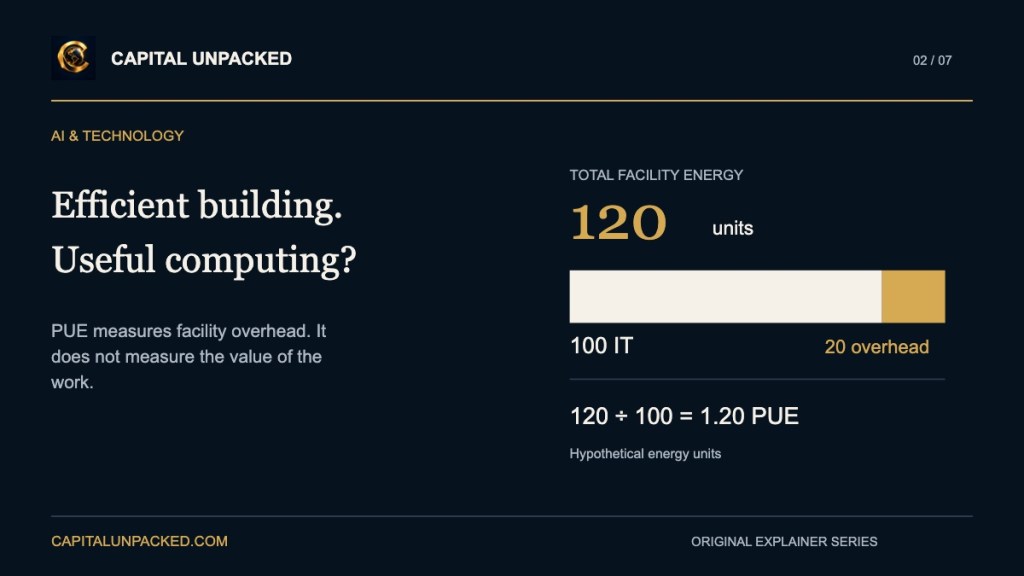
The U.S. Department of Energy defines PUE as total facility energy divided by IT equipment energy. It captures the overhead around computing, rather than the usefulness of the computing itself. Annual measurements help account for seasonal conditions and changing loads.
In our hypothetical illustration, IT equipment uses 100 energy units and cooling, distribution and other overhead use 20. Total consumption is 120, so PUE is 1.20. Reducing overhead to 10 with IT energy unchanged brings it to 1.10. That is a real reduction in facility energy under those assumptions. It says nothing about revenue, model quality or jobs completed.
Now change the question. If the site uses less energy per unit of IT demand but runs twice as much equipment, total electricity consumption can rise. A ratio and an absolute total answer different questions. Likewise, low overhead does not establish that customers are paying for enough computing to cover the equipment bill.
For an AI infrastructure story, read PUE alongside total energy, a clearly defined measure of computing output, utilization and costs. Check the measurement period and boundary before comparing facilities. The editorial lesson is simple: ask what a metric includes before treating it as proof of an entire business model. Efficient cooling matters. It is one part of the story.
Source: U.S. Department of Energy: data center design guide, July 2024. Definitions checked 27 October 2026. Calculations and illustrations by Capital Unpacked.

