
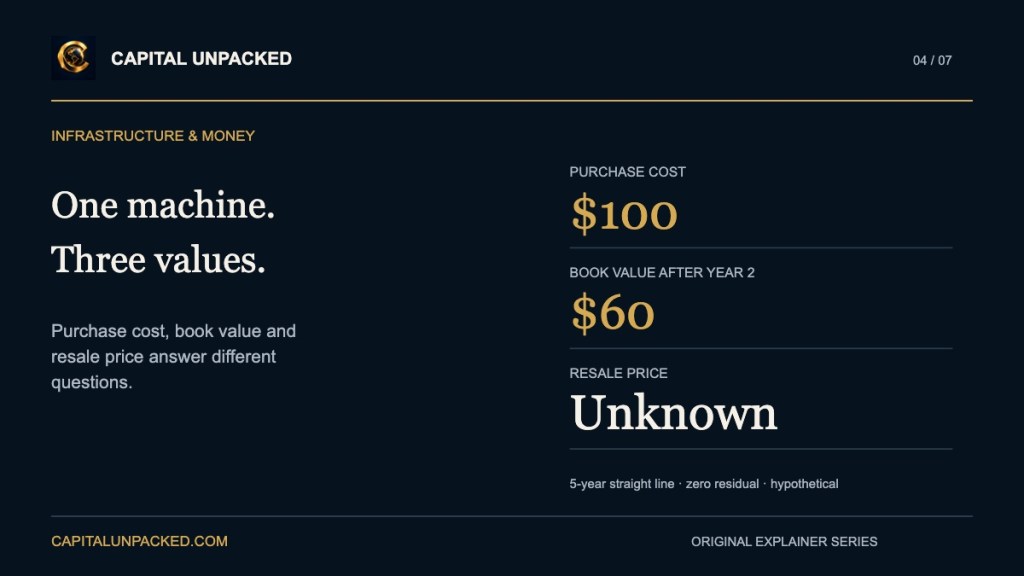
Suppose a machine costs $100 and its cost is allocated evenly across five years, with no residual value. Two years later, its book value is $60. That calculation cannot tell you what a buyer will offer for it.
The Federal Reserve’s accounting manual describes straight-line depreciation as allocating acquisition cost less estimated salvage value over an estimated useful life. Its specific policies apply to Reserve Banks; the simplified calculation here illustrates the mechanism, not a rule that all technology companies must follow.
In our hypothetical example, annual depreciation is $20. The asset’s carrying amount falls from $100 to $80 after one year and $60 after two, before any other accounting adjustments. If a buyer then offers $35, the offer and the accounting schedule are describing different values. Neither the five-year life nor the $35 offer is a statement about real GPU markets.
For AI equipment, the business question is what cash the hardware can earn while competitive, and what it might recover when sold. A useful-life estimate does not guarantee customer demand for that entire period. A secondary-market quote also needs context: model, condition, location, quantity and transaction date.
When a financing story relies on equipment retaining value, separate the original invoice, the carrying amount and the assumed disposal proceeds. Ask who bears a shortfall if resale is weaker than expected. This is why an accounting schedule should not become a price forecast in a headline. The equipment can have one physical identity and several economically distinct numbers attached to it.
Source: Federal Reserve: property and equipment accounting manual, Chapter 3. Definitions checked 27 October 2026. Calculations and illustrations by Capital Unpacked.

