
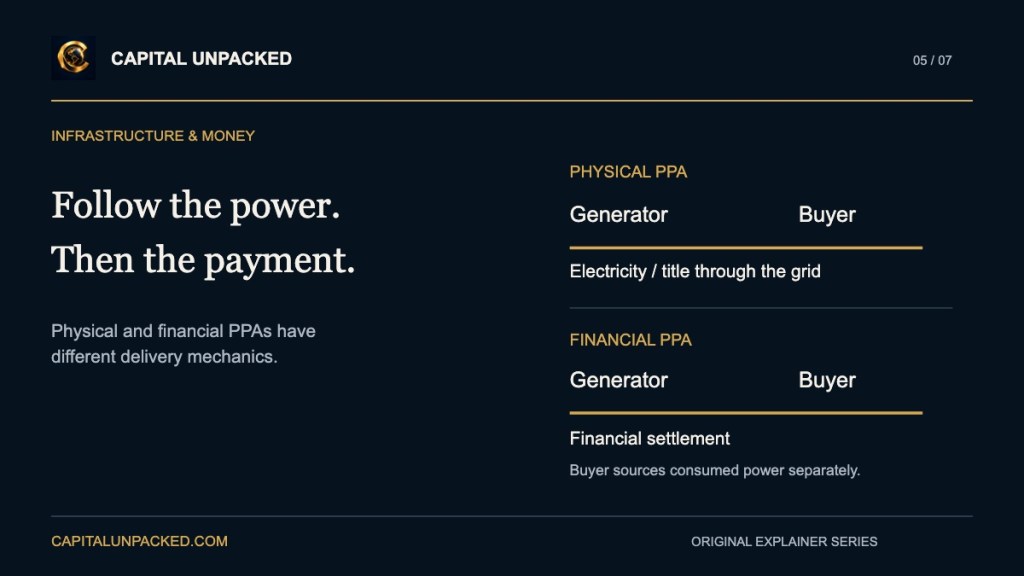
An AI company announces a power agreement. Before treating that as electricity arriving at a campus, identify what kind of agreement it signed. The financial relationship and the physical supply relationship may follow different paths.
The EPA distinguishes physical power purchase agreements, where the buyer receives electricity or title to it through the grid, from financial PPAs, where that delivery does not occur between the counterparties. Its physical PPA guidance also emphasizes that renewable energy certificate ownership needs checking before making green-power claims.
Imagine two simplified situations. In the first, a buyer has an agreed physical delivery arrangement for a project’s electricity. In the second, the buyer and generator exchange financial payments under their contract, while the buyer obtains its consumed electricity separately. Our diagram shows that structural difference; it does not reproduce the terms of an actual deal or suggest that every agreement uses identical settlement rules.
The practical reading questions follow the two paths. For electricity: where is the project, what connects it to the relevant market, and when can delivery start? For money: what determines payments, how long do obligations last, and which party takes each contractual risk? Then check who owns the associated environmental attributes.
A procurement agreement can serve a valuable purpose without being a dedicated, continuously available supply line to a data center. To understand a headline, follow both electricity and payments before deciding what has been secured. The name of the contract is a starting point; the actual terms determine its operating meaning.
Source: U.S. EPA: Physical PPA. Definitions checked 27 October 2026. Calculations and illustrations by Capital Unpacked.

