
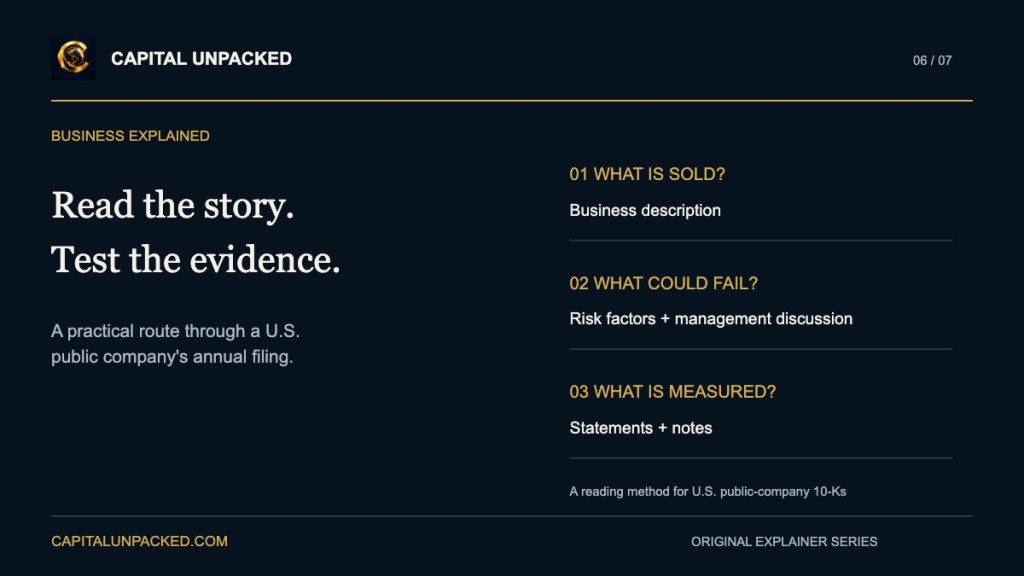
A compelling growth narrative deserves more than a glance at the opening slide. For a U.S. public company, its annual Form 10-K offers a route from what management says to the business details behind the claim. Here is an original three-question reading method.
Investor.gov explains that a 10-K covers the business, significant risks, management’s discussion of results and audited financial statements. These sections perform different jobs. Reading them together can expose questions that a single headline does not answer.
First, ask what is being sold. A hypothetical company describing itself as an AI infrastructure platform might sell equipment, rent capacity or provide a managed service. Those models have different customers and obligations. Write a one-sentence description in ordinary language and check it against the business section.
Second, ask what could stop delivery. Use risk factors as a prompt to look for dependencies: customers, suppliers, power, financing or execution. Then inspect management’s discussion for what happened during the period. A disclosed risk is not proof that the problem occurred, and an optimistic discussion is not independent verification that it has been resolved.
Third, ask what the reported numbers actually measure. Check the period, units and definitions, then follow the relevant financial statements and notes. Our method is a reading framework, not a rating system or a claim about a specific company. The aim is to turn a broad story into testable questions: what is sold, what constrains it and what evidence supports the result. A document is most useful when you arrive with a precise question.
Source: Investor.gov: How to Read a 10-K. Definitions checked 27 October 2026. Calculations and illustrations by Capital Unpacked.

