
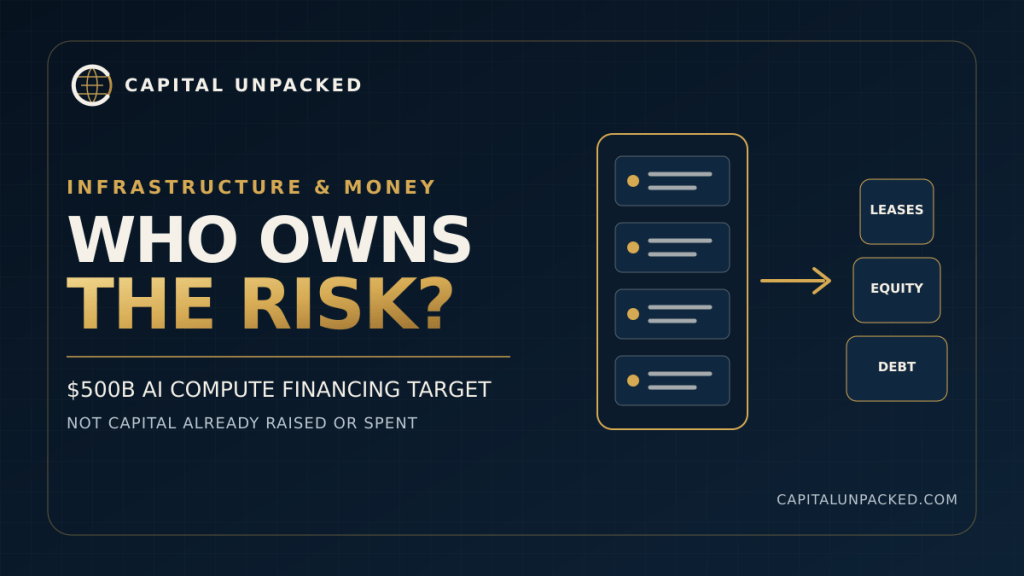
Infrastructure & Money
The headline is $500 billion. The real story is who owns the risk.
NVIDIA and six major capital providers want to make AI compute financeable at global scale. But the number being discussed is a target to mobilize third-party capital over time—not money already raised, committed or spent.
AI infrastructure is beginning to look less like a technology purchase and more like project finance.
On August 10, 2026, NVIDIA announced memorandums of understanding with Apollo, BlackRock, Blackstone, Brookfield, Goldman Sachs and KKR. The stated ambition is to establish independent financing platforms capable of mobilizing more than $500 billion of third-party capital for AI infrastructure over time.
That is a consequential proposal. It is also easy to misread. NVIDIA did not announce that it had invested $500 billion, raised $500 billion or secured $500 billion in binding commitments. Its August announcement—and the company’s subsequent quarterly results—said the partnerships remained subject to definitive agreements.
What actually changed
The traditional way to buy GPUs is straightforward: a cloud provider, data-center operator or AI company spends its own capital, owns the hardware and carries the depreciation risk. The proposed platforms would bring large pools of institutional capital into that process.
- Investors or lenders provide capital for compute equipment and associated infrastructure.
- An operator owns or manages the assets.
- An AI company, cloud provider or other customer pays through leases, usage contracts or related revenue arrangements.
- Those contracted payments are intended to support financing costs and investor returns.
In principle, this can move part of the AI buildout away from corporate balance sheets and into dedicated financing vehicles. That matters because the required capital extends beyond chips: facilities, power connections, cooling, networking and supporting infrastructure all have to arrive together.
What the $500 billion number means
| What it is | A target to mobilize third-party capital over time through proposed financing platforms. |
| What it is not | Cash already deployed, capital already raised or a binding commitment from NVIDIA itself. |
| Current legal status | Memorandums of understanding, subject to definitive agreements. |
| Why it matters | It signals an attempt to establish AI compute as an institutionally financed asset class. |
The distinction is central. A financing ambition describes capacity the platforms hope to create. Committed capital exists only when investors enter binding agreements. Deployed capital exists only when money is actually drawn and put into assets. Treating those stages as interchangeable exaggerates what has already happened.
There is already a working model
The concept is not purely theoretical. In January 2026, Apollo announced that its funds and affiliates led a $3.5 billion capital solution supporting Valor’s $5.4 billion acquisition and lease of data-center compute infrastructure, including NVIDIA GB200 systems, to an xAI subsidiary.
The transaction used a triple-net lease structure. In simplified terms, the lessee bears major operating costs while the financing vehicle owns the compute assets and receives contractual payments. That can make hardware-backed cash flows easier for institutional investors to analyze—but it does not eliminate the underlying risks.
Why a GPU is not a power plant
Long-lived infrastructure is usually financed against assets expected to operate for decades. AI accelerators are different. Their economic value depends on utilization, customer credit, software compatibility, power availability and the arrival of faster hardware.
The bullish case
- Scarce compute can support long-duration contracts.
- Assets can potentially move between customers or workloads.
- CUDA software may extend the productive usefulness of NVIDIA systems.
The underwriting risks
- Utilization may fall below projections.
- Customers may be concentrated or credit-sensitive.
- New generations can reduce residual hardware value.
- Power or grid delays can strand expensive equipment.
NVIDIA’s claims about token cost, revenue generation and useful life are the company’s own investment case, not independently verified guarantees. Investors still have to determine what the equipment will earn, how quickly it will depreciate and who absorbs the loss if demand changes.
Who could benefit—and who carries the downside
If the model scales, chip vendors gain a broader financing channel for customers. Data-center operators and AI companies gain access to infrastructure without funding every asset directly. Power providers, networking companies and cooling specialists participate in the surrounding buildout. Asset managers and lenders gain a new category of fee-generating and interest-bearing products.
But risk does not disappear when an asset moves into a financing vehicle. It is redistributed among equity investors, lenders, operators, guarantors and customers. The decisive questions are not only how many GPUs can be financed, but whether the contracts are durable, the customers remain solvent and the hardware retains economic value.
The next phase of AI may be decided as much by underwriting discipline as by model performance.
Why it matters
The AI boom has already become an infrastructure story. The financing layer is the next step. If compute can produce reliable, contract-backed cash flows, institutional capital can accelerate construction at a scale corporate balance sheets alone may struggle to support.
If those assumptions fail, however, investors could discover that rapidly depreciating technology behaves very differently from conventional infrastructure. That tension—not the headline number—is the story to watch.
Primary sources
- NVIDIA announcement, August 10, 2026
- NVIDIA fiscal Q2 2027 results, August 26, 2026
- Apollo Valor/xAI transaction, January 7, 2026
Sources rechecked October 20, 2026. This article is for informational purposes and is not investment advice.
Understand the money behind the infrastructure.
Capital Unpacked explains the business models, financing and physical systems shaping the AI economy.
Get the next story
Subscribe to Capital Unpacked for new documentaries and research-driven analysis.

